The pitcher on the stage
Text by Pınar Öğrenci included to ‘The Broken Pitcher’ exhibition publications.
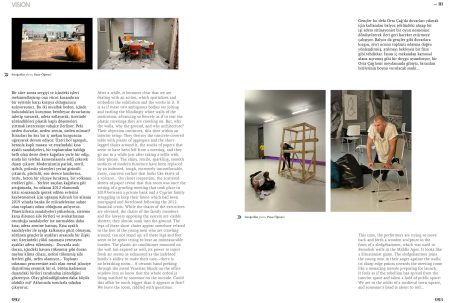
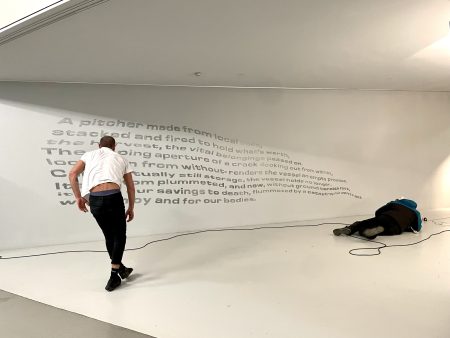
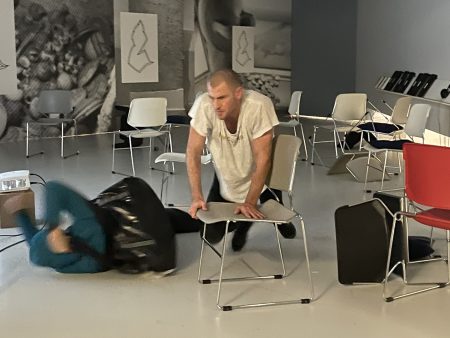
We are standing across a slightly sloping ramp. A backpack full of knick-knacks is shifting between two young men struggling to stand up; it’s unclear to whom it belongs. Who are these two young men trying to move forward by crawling, stumbling, rolling, necking and backing each other, running back and forth? Two vagrants, two drunks, two addicts, two homeless refugees or two young urban guerrillas? So, who are they?
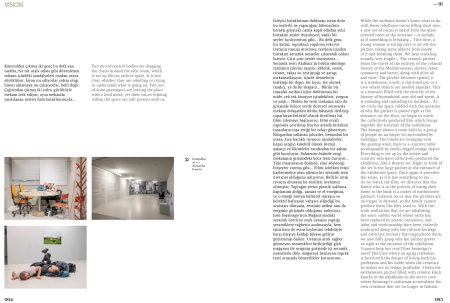
After a while, it becomes clear that we are dealing with an action, which spatializes and embodies the exhibition and the works in it. It is as if these two ambiguous bodies are jolting and rattling the blindingly white walls of the institution, advancing so fiercely as if to tear the plastic coverings they are crawling on. But, why the walls, why the ground, and why architecture? Their objection continues, this time within an interior setup: They destroy the concrete-covered table with plenty of aggregate and the short-legged chairs around it, the stacks of papers that seem to have been left from a meeting, and they go out in a while just after taking a selfie with their phone. The shiny, sterile, sparkling, smooth surfaces of modern furniture have been replaced by an indented, rough, extremely uncomfortable, dusty, concrete surface that looks like skirts of a volcano… On closer inspection, the scattered sheets of paper reveal that this room was once the setting of a grueling meeting that took place in 2019 between a private bank and a Cypriot family struggling to keep their home which had been mortgaged and foreclosed following the 2012 financial crisis. While the chairs of the executives are elevated,the chairs of the family members and the lawyers opposing the system are visiblyshorter; they almost sunk into the ground. The legs of these short chairs appear somehow related to the feet of the young men who are crawling around, can not stand up; all these legs and feet seem to be spent trying to bear an immeasurable burden. The plastic air conditioner mounted on the wall has expired as well, its power to inject fresh air seems as exhausted as the indebted family’s ability to make their case—there is no breathing room… A ceramic hand peeking through the metal Venetian blinds on the office window lets us know that the whole ordeal is being watched by someone on the outside. Could this affair be much bigger than it appears at first? We leave the room, riddled with questions.
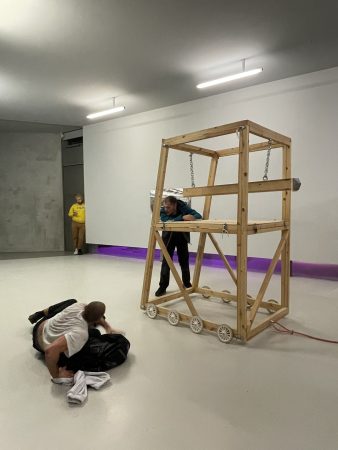
This time, the performers are trying to move back and forth a wooden sculpture in the form of a sledgehammer, which was used to demolish walls in the Middle Ages. It looks like a Situationist game. The sledgehammer joins the young men in their anger against the walls; its sharp edge points towards the meeting room like a menacing missile preparing for launch. It feels as if the rebellion has spread from the interior space and taken a hold of public space: We are in the midst of a medieval town square, and someone’s head is about to roll… Two out-of-control bodies are dragging the chairs around the next room, which is set up like an archive space. It is not clear whether they are rebelling or trying to understand what is going on. Two out-of-state passengers are leaving the place with a loud noise; yet their voices echoing within the space are still present with us.
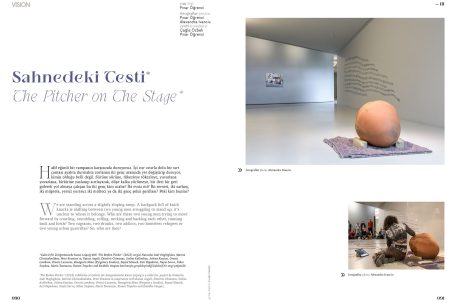
While the audience doesn’t know what to do with these rebellious voices filling their ears, a new set of voices is heard from the glass-covered room at the entrance —it sounds as if something is breaking… This time, a young woman is sitting next to an old clay pitcher, taking some objects from inside of it and breaking them. We hear crackling sounds, very fragile… The ceramic pitcher bears the traces of the entirety of the colonial history of the Mediterranean; slavery, labor, commerce and barter, along with olive oil and wine. The pitcher becomes spatial, it is a warehouse, a well, a clay-lined pit, or a cave where objects are nestled together. This is a stomach filled with the entirety of the history of humankind; now old and spent, it is vomiting and unloading its burdens…
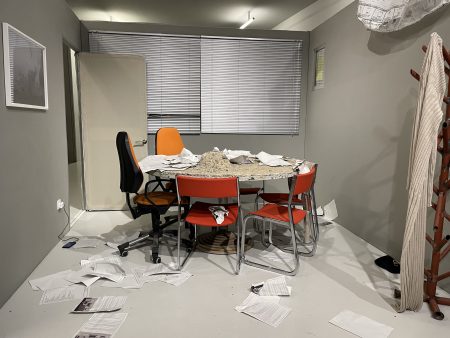
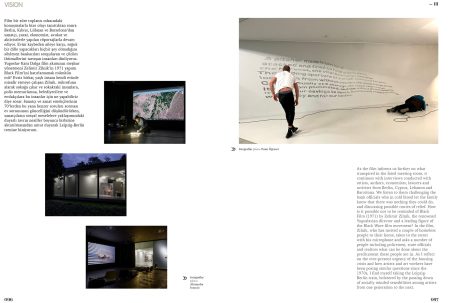
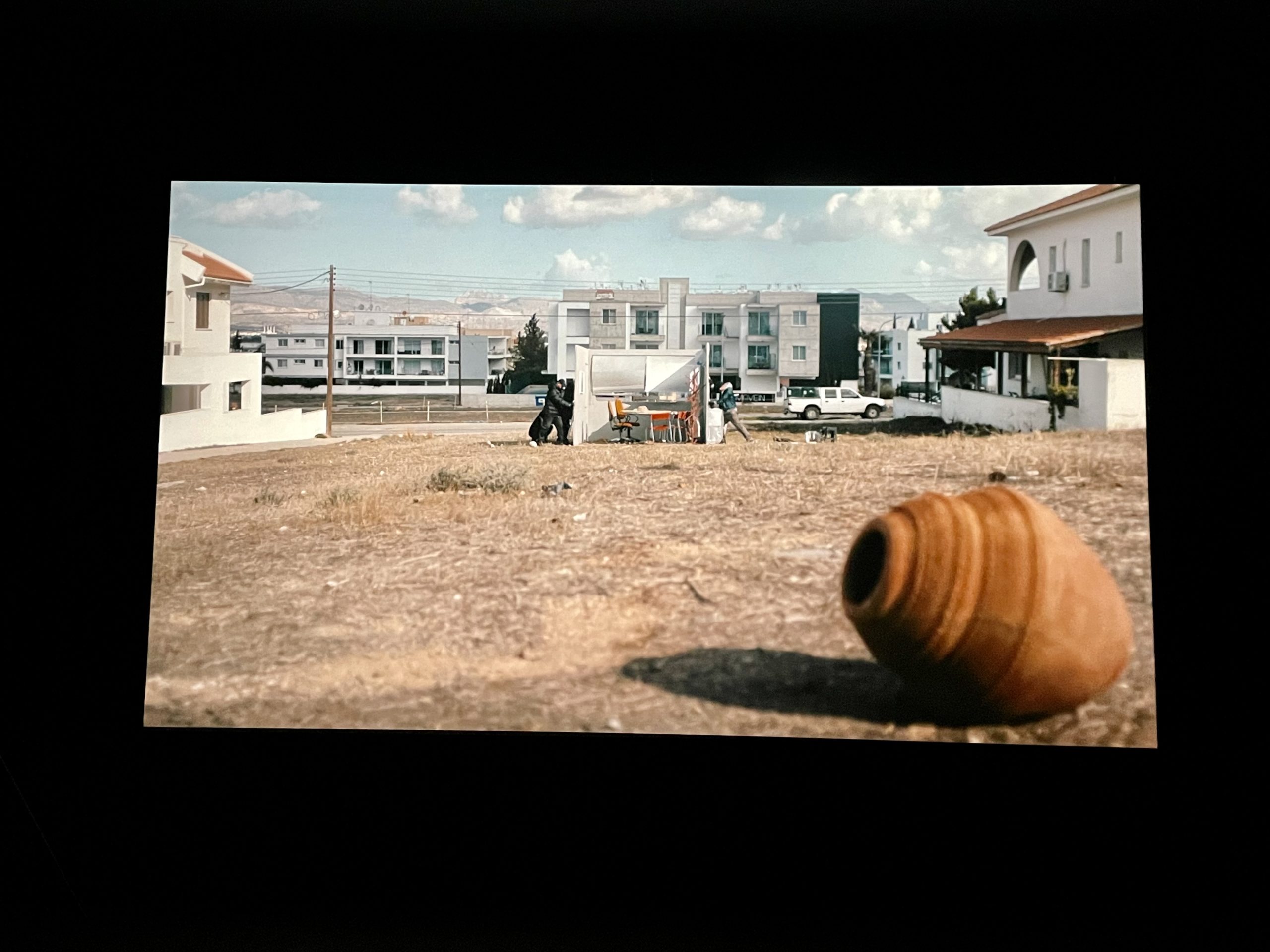
As we circle the space riddled with the question of why the pitcher is placed right at the entrance, on the floor, we begin to watch the collectively produced film which brings together the storyline of the exhibition. The footage shows a room built by a group of people on an empty lot surrounded by buildings. The blinds are swinging with the gusting wind, there is a concrete table accompanied by stocky-legged orange chairs: Everything is set up by the artists and curators who have collectively produced the exhibition, like a theater set. Right in front of the set is the large pitcher at the entrance of the exhibition space. Once again it precedes the scene, as if it has something to say… As we watch the film, we discover that the family who is in the process of losing their home to the bank is a maker of earthenware pitchers. It dawns on us that the pitchers are no longer in demand, so the family cannot produce them like they used to. With the stark realization that we are inhabiting the same violent world where earth has been replaced by plastic containers, and labor and workmanship have been violently eradicated along with the cultural heritage and collective memory that engendered them, we now fully grasp why the pitcher greets us right at the entrance of the exhibition. I cannot help but recall Jose Saramago’s novel The Cave where an aging craftsman is faced with the danger of losing both his profession and his home when the ceramics he makes are no longer profitable. I liken the earthenware pitcher filled with ceramic knick knacks in the exhibition to the secret cave where Saramago’s craftsman accumulates his own creations that are no longer in fashion.
As the film informs us further on what transpired in the fated meeting room, it continues with interviews conducted with artists, authors, economists, lawyers and activists from Berlin, Cyprus, Lebanon and Barcelona. We listen to them challenging the bank officials who in cold blood let the family know that there was nothing they could do, and discussing possible routes of relief. How is it possible not to be reminded of Black Film (1971) by Zelimir Zilnik, the renowned Yugoslavian director and a leading figure of the Black Wave film movement? In the film, Zilnik, who has invited a couple of homeless people to their home, takes to the street with his microphone and asks a number of people including policemen, state officials and realtors what can be done about the predicament these people are in.
As I reflect on the ever-present urgency of the housing crisis and how artists and art workers have been posing similar questions since the 1970s, I find myself taking the Leipzig-Berlin train, bolstered by the passing down of socially minded sensibilities among artists from one generation to the next.
‘The Broken Pitcher’ (2023) exhibition at Galerie für Zeitgenössische Kunst Leipzig is a collective project by Natascha Sadr Haghighian, Marina Christodoulidou, Peter Eramian in cooperation with Raissa Angeli, Dimitris Chimonas, Stelios Kallinikou, Athina Kassiou, Orestis Lambrou, Orestis Lazouras, Panagiotis Mina (Pyrgatory Studios), Faysal Mroueh, Keti Papadema, Nayia Savva, Nikos Stephou, Maria Toumazou, Rumen Tropchev and Emiddio Vasquez.
Photographs by Pınar Öğrenci from ‘The Broken Pitcher’* exhibition at GfZK, Leipzig, 2023.
Turkish version ‘Sahnedeki Testi’ published by VISIO in 2023.