Interview, Berliner Gazette, 2025
Interview by Magdalena Taube/Krystian Woznicki and Pınar Öğrenci for The Cemetery of the Nameless solo exhibition at Wedding Galerie.
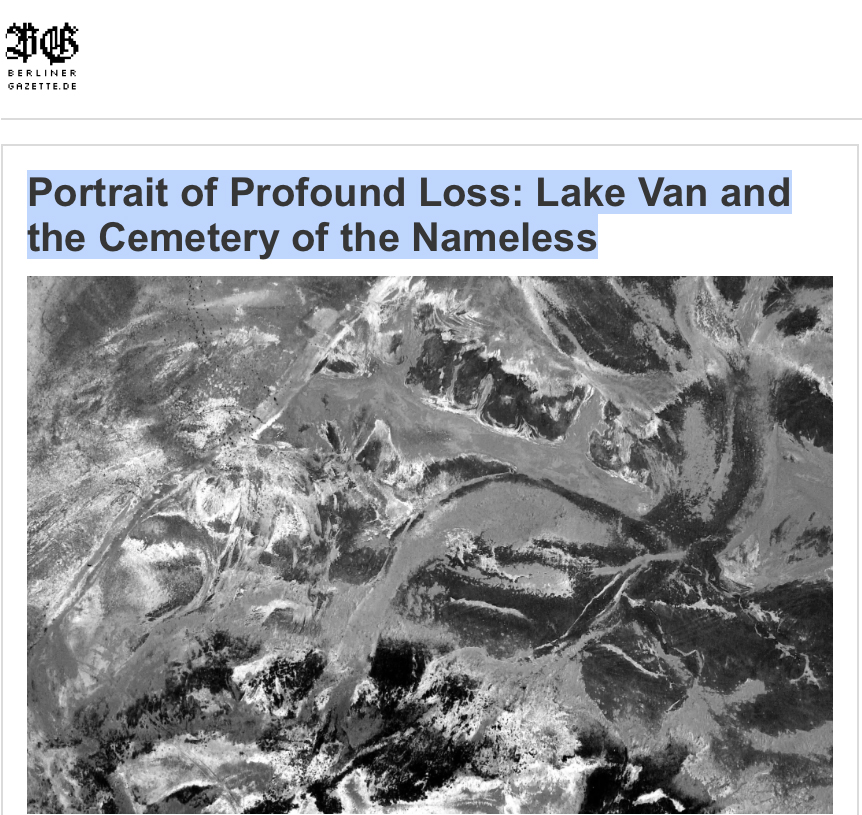
The landscape surrounding Lake Van in Turkey is part of a route that people use to flee Iran or Afghanistan and enter Turkey. The cemeteries in the Van region serve as a dehumanizing testament to the migrants who lost their lives in this landscape. Many drowned in the shrinking lake, which is a victim of the climate crisis. The exhibition “Cemetery of the Nameless,” by artist Pınar Öğrenci, explores the ecological, historical, and social aspects of Lake Van, offering a haunting portrayal of a region defined by profound loss. In this interview, the artist reflects on the process and ideas behind her project.
Magdalena Taube/Krystian Woznicki: You are from Van, a city in eastern Turkey located on the eastern shore of Lake Van near the borders of Iran, Iraq, and Georgia. It is a complex, multilayered geocultural landscape characterized by histories of displacement and genocide. What childhood memories do you have of this place?
Pınar Öğrenci: The demographic composition of Van, a city with a predominantly Armenian and Kurdish population, changed after the 1915 Armenian Genocide, when Turks were brought in from various parts of Anatolia. Add to that the Armenians who converted to Islam to escape the genocide, as well as the assimilated Kurds, and it was clear that Turkish identity was dominant in the city where I grew up – at least in the city center. Talking about the Armenian Genocide, or even Armenians, was a huge taboo. Speaking Kurdish, publishing in Kurdish, and organizing Kurdish cultural activities were all prohibited. These prohibitions were the result of the 1980 military coup. The coup suppressed not only the Kurds but also all intellectual and leftist groups in Turkey. Thousands of people were imprisoned, while others fled to Europe and went into exile. I spent my childhood and early adulthood under the shadow of the 1980 military coup.
In 1990, I moved to Istanbul to study architecture. During that time, Kurds fleeing oppression in Hakkari, Ağrı, and Muş began migrating to Van. The 2011 earthquake, the migration of the middle and upper classes to western Turkey, and the construction of new housing during the city’s reconstruction provided new impetus for Kurdish migration from surrounding cities. Today, Van is a crowded, dynamic city with a predominantly Kurdish population.
Magdalena Taube/Krystian Woznicki: In your exhibition, “Cemetery of the Nameless,” you explore the landscape surrounding Lake Van. This area is part of a route that people use to flee Iran or Afghanistan for Turkey. If they survive, they continue on to Europe. The cemeteries in the Van region serve as a dehumanizing index of deceased migrants who lost their lives in this landscape. Instead of featuring people’s names on the poles, there are only Rather than featuring people’s names on the poles, only forensic registration numbers and locations related to the migration route and its end are featured. How did your encounter with these cemeteries inspire you to explore the landscape as both a death zone and a space of mourning?
Pınar Öğrenci: Zeynep Sayın’s book, “Ölüm Terbiyesi” (“Death Training”), was published in 2018. Through this remarkable book on state violence, punishment, body politics, and the absence of graves that I first encountered the term Cemetery of the Nameless. Through online research, I discovered that the largest Cemetery of the Nameless in Turkey is located in Van. When I was invited to documenta fifteen in 2022, I wrote a project proposal interpreting the city of Van through Armenian, Kurdish and refugee graves.
The proposal aimed to examine the city’s historical body and punishment politics, and it was accepted. However, since we did not receive the filming permit from the Ministry of Culture in time, I directed the film crew to Müküs (also known as Bahçesaray), where we shot the film “Aşît” (“The Avalanche”), my backup plan. After documenta fifteen opened in 2022, I created my first video work related to the Cemetery of the Nameless for an exhibition at the Istanbul Cendere Museum. In 2023, we exhibited a two-channel version of the same piece at an exhibition in Nordichouse Iceland. The Cemetery of the Nameless is a long-term project that I continue to work on.
The harsh suppression of the first Armenian uprisings in 1896, the Armenian Genocide of 1915, the Zilan Stream Massacre of 1930, the ‘33 Bullets’ incident (also known as the ‘Sefo Stream (Sefo Deresi) Massacre) of 1943, the disappearance of Kurds since the 1990s, and the deaths of refugees crossing the border all point to a continuous history of state violence in the city. Therefore, the landscape of mountains, rivers, and lakes can be considered a setting for this violence as well as a witness to it. As I looked at the accumulated waters of the lake, I began to see it not only as stagnant water, but also as a vessel – a place where bodies, along with their stories, are carried and stored, almost like an archive. The contrast between the magical beauty of the landscape and the harsh stories it contains made me view the landscape as more than just a physical form; it is also a repository of stories and memories. A similar tendency is present in “Aşît.”
…
Please use the interview link above for the full text in English and German.