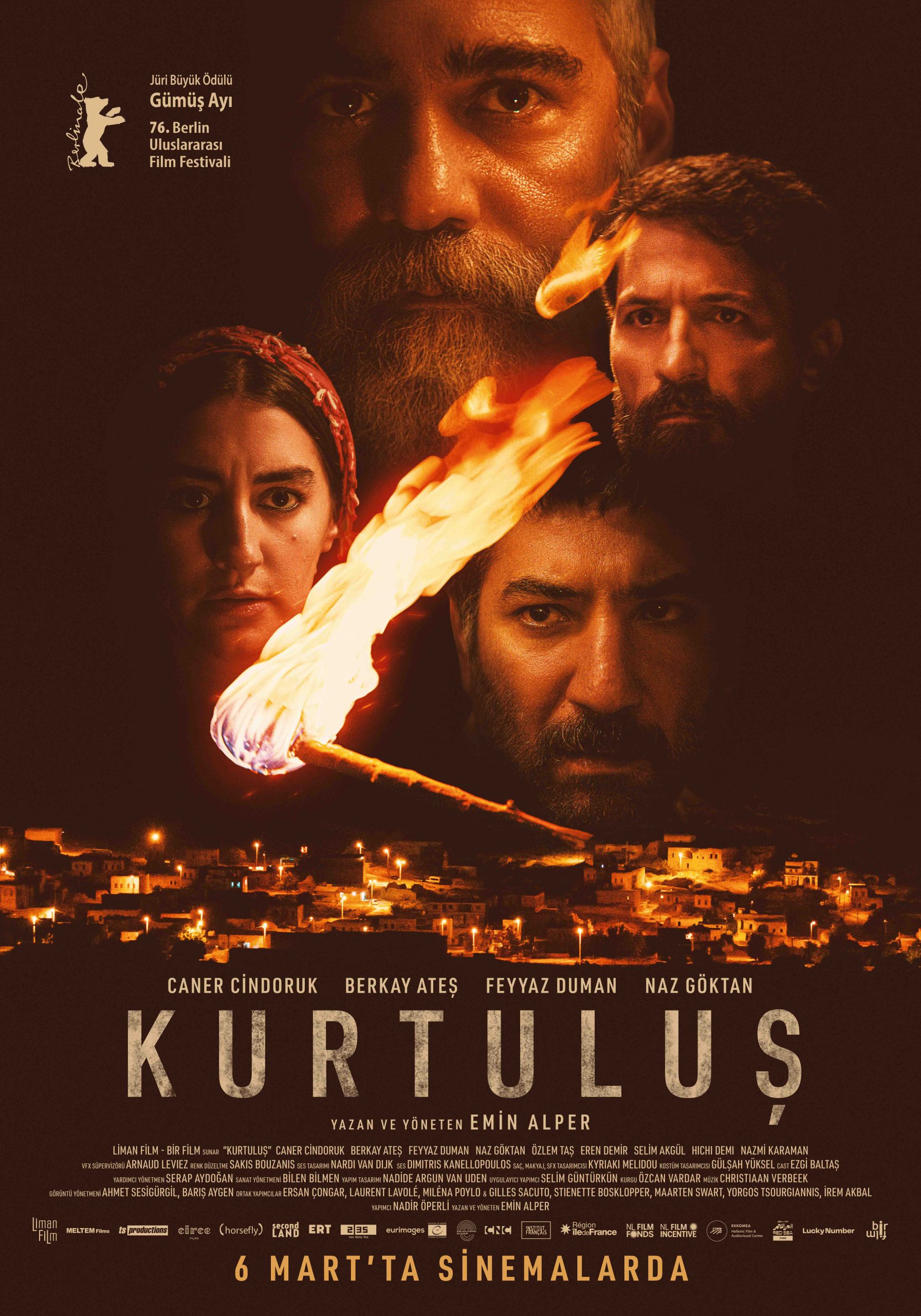
Original version in Turkish, K24, 2026
Emin Alper’s Film ‘Salvation’, Collective Trauma, and the Function of Art
Pınar Öğrenci
In this essay on Salvation (Kurtuluş), directed by Emin Alper and awarded the Silver Bear at the 2026 edition of the Berlin International Film Festival (Berlinale), I would like to discuss not so much the film’s aesthetic integrity but the social role of the artist—particularly of a politically positioned director. Cinema is not merely a field of aesthetic production; it is also a realm of possibilities that shapes collective memory and reconstructs or transforms trauma. Especially when narratives concern communities that have historically been oppressed or subjected to violence, representation is not simply an artistic choice—it is an ethical and political responsibility, as was widely debated throughout this year’s Berlinale.
The film draws on a real story about Kurdish village guards. Yet the fact that the story is constructed by a Turkish director lies at the center of our discussion: How does a director coming from a dominant identity represent the trauma-laden experience of an oppressed people? Where does he position himself within the narrative? When speaking from within a political structure historically associated with violence—or identified with its perpetrators—is he aware of the asymmetrical nature of representation?
Village Guards and the Invisibility of the State
The film is built around the tension between a village that agrees to become village guards and another that refuses and migrates. The guards seize the lands of those who leave and begin farming there. After some time, however, the displaced villagers gradually return, and the guard village begins threatening them out of fear of losing the lands they appropriated. Meanwhile, the leaders of the guard village are driven by religious-mystical beliefs; drifting between dream and reality, they eventually succeed in mobilizing villagers who, we have already been led to believe, are eager to kill. In the end, the guards massacre all the inhabitants of the lower village. Only a young girl survives by hiding herself.
The village guard system was one of the main instruments of the state’s security policies in Kurdish regions in Türkiye throughout the 1990s. Families that accepted becoming village guards were armed by the state and assisted the military in the counter-insurgency war. Village guards were effectively granted the right to kill under the pretext of security. They received a monthly salary from the state for acting against the Kurdish movement.
By creating internal divisions within Kurdish society—between those aligned with the state and those who were not—it aimed both to weaken political resistance and fracture the social fabric. At its core was the exploitation of segments more inclined toward feudal relations and religious ties for the benefit of the state. The system not only turned Kurds against one another but also made citizenship conditional. Those who refused to arm themselves were subjected to various forms of pressure and ultimately forced to abandon their lands and flee.
The roots of the village guard system can be traced back to the Hamidiye Regiments established in the late nineteenth century by Sultan Abdul Hamid II. He armed Sunni groups, including Kurds, to attack Armenians, effectively setting his own subjects against one another.
Yet Salvation renders this institutional and historical background invisible. The state’s role in establishing the village guard system goes unquestioned; gendarmerie and military figures are portrayed as almost neutral, well-intentioned, smiling, and peaceful characters. Thus, while the structural dimension of violence is erased, what remains is a narrative of “Kurds killing Kurds” as an internal savagery.
We never see under what conditions the displaced villagers left, where they went, or what happened to them. Did they flee abroad as migrants? Did they escape through illegal routes, like many Kurds displaced in the late 1980s, waiting in refugee camps and seeking asylum? Or did they migrate to big cities such as İzmir or Istanbul, trying to cling to urban life? None of these questions—nor the sociology of forced migration, the experience of exile, or collective trauma—find space in the film. Instead of confronting the political causes of displacement, the viewer sees only the “threatening” presence of the returnees. This representational strategy reduces structural violence to individual malevolence.
I can say that the film’s hierarchical spatial design, which moves upward and downward, is striking; it confines the viewer between the houses of the religious leaders of the village guard settlement and the lodge where they worship. However, since the hierarchical spatial structure does not incorporate the lower village or the state, it ultimately serves only to emphasize the aggressiveness of the upper village—in other words, the slopes always lead to the same place. Protected courtyards, narrow corridors, endless staircases, steep slopes, and cliffs at the end of the road frame religious, savage, merciless villagers thirsty for death, who ultimately annihilate the inhabitants of the other village within this atmosphere of collective frenzy. The masculine sound effects accompanying their oscillation between dream and reality create a suffocating environment, imposing a bodily sense of constriction on the audience.
The crucial question, however, is this: Is this aesthetic choice constructed to interrogate violence, or does it feed on violence’s capacity to produce sensory pleasure? Rather than exploring alternative narrative possibilities, the camera persistently gravitates toward the spectacle of execution. Violence is presented repeatedly and with increasing intensity; instead of creating critical distance, it aestheticizes violence. In doing so, the film reproduces trauma rather than transforming it.
The Director’s Body as a Doctor and Figure of Authority
Midway through the film, the director himself appears in a white coat, acting as doctor. This brief but symbolic scene concretizes the question of representation. The doctor, clearly foreign to the region, approaches a pregnant village woman in a harsh and distant tone. He embodies not merely a minor character but the personification of dominant knowledge and paternalistic modernity. The scene recalls colonial regimes of knowledge: the condescending, all-knowing “white man” who governs rather than heals. It echoes the doctors Kurds knew well from the 1970s, ’80s or ’90’s—those who mistreated patients for not speaking Turkish. A micro-level reproduction of colonial epistemology.
Similarly, at the editing table, the director performs a kind of surgical intervention; he cuts open the film as if operating on a body, pumping so much adrenaline and blood that what emerges is not healing but a breathless narrative.
Writing about this Anatolian story, I cannot help but think of Kurdish novelist Yaşar Kemal, who criticized the feudal structures of the lands where he grew up. He once said he struggled to prevent his characters from killing one another, that he delayed the moment of murder as long as possible, and that he suffered while writing those scenes. His long descriptions of nature, the trembling rebellious mountains, the mournful sound of a caval from a distant village—all were ways of postponing that fatal moment. In Yaşar Kemal’s stories, violence is a threshold resisted by the writer’s own body; delaying violence can be read as both a literary strategy and an ethical intervention.
Collective Trauma and the Function of Art
In recent years, a vast body of literature has emerged on art’s potential to heal collective trauma, reconstruct memory, and create spaces for confrontation. Cinema, with its audiovisual tools, is among the most powerful carriers of this potential. Through layers of music, mythology, archives, animation, and poetry, film has the capacity to transform even the darkest stories—to suspend, even temporarily, our gaze toward the “other,” and reshape it.
Yet Salvation leans instead on a one-dimensional narrative of violence. Nearly all Kurdish characters—guard or migrant, woman or man, adult or child—are portrayed as prone to violence. Even those who initially refused to become guards gradually choose that path upon their return. This homogenization recalls colonial narratives of “native savagery.” The dream scene in which children march at midnight with torches to burn a village suggests the intergenerational transmission of violence.
The representation of women is similarly problematic. A woman from a guard family stands armed on night watch, borrowing the resistant image of the Kurdish women’s movement but detaching it from its political context and criminalizing it. Resistance is thus stripped of its emancipatory dimension and reduced to irrational violence.
Structurally, the film aligns with the Republic’s secular, homogenizing “salvationist” ideology—one that erased lodges and madrasas without acknowledging their positive aspects, sought to Westernize Anatolian people, urbanize and “tame” Kurds, and thereby assimilate them. When combined with the smiling soldier and gendarmerie characters, the film appears from the outset to rest on a statist framework.
The Final Scene and the Displacement of the Perpetrator
In the final scene, the film heightens the dose of violence to its peak. The guards blame the massacre on “terrorists,” covering up the crime. This is not unfamiliar: in the 1990s, the state blamed the PKK for killings of Kurdish villagers carried out by the military, emptying dozens of villages and displacing thousands. Yet rather than confronting this historical reality, the film displaces the perpetrator once again, rendering the state invisible.
What kind of healing can be offered to a people already burdened with trauma by repeating a village guard story— even if true—while excluding its historical context and attributing violence to internal community dynamics? In a media climate saturated with racist rhetoric undermining peace efforts, should the artist’s task be to salt the wound or to help heal it? Were the academics who paid for their solidarity with the Kurdish people—by signing a peace petition and being dismissed and forced into exile—struggling in vain? This film raises questions about the cinematic equivalent of the language of solidarity established in the past by the director. Similarly, there is a serious inconsistency between the director’s solidarity-based “you are not alone” speech at the awards ceremony of Berlinale and the language of the film itself.
While reinforcing a discriminatory state structure, Salvation unexpectedly aligns with dominant nationalist discourse. Its final massacre scene pours salt into the wounds of the Kurdish people.
Could we imagine an Israeli director making a film about Palestinians without acknowledging Israel’s role as occupying power? Or a white American director making a film about African Americans while ignoring white racist domination? Such works would be considered propaganda and would likely provoke strong reactions from festival juries. By failing to recognize this fundamental issue, the Berlinale jury seems to have erred from the outset.
The Berlinale Problematic
That such a problematic film received an award at Berlinale is part of a broader crisis of representation at the festival. Jury president Wim Wenders’s refusal to speak about the genocide in Gaza and his statement that “cinema is not political” shaped the framework of this year’s festival. I must say that I was not surprised by Wim Wenders’s statement. Wenders’s unacceptable remark that “cinema is not political” can be seen as a continuation of the silence many German intellectuals have maintained in the face of genocide. Just as Germans were slower than the Italian neorealists to respond to Nazism, today’s silent German left appears similarly slow to grasp and react to what is happening. When we compare the Italians—who fill the streets with protests and organize strikes—with Germans who quietly retreat into their comfortable corners, we can perhaps better understand the roots of this disturbing silence.
The awards granted to Turkish directors may be read as an attempt to restore the festival’s waning prestige. Considering that the largest immigrant group in Germany comes from Turkey, this strategy of self-legitimation becomes easier to understand.
Yellow Letters, directed by İlker Çatak and awarded the Golden Bear at Berlinale, is a clever example of scriptwriting, editing, and good acting. The film shifts locations between Turkey and Germany, implying that the current crisis of human rights in Turkey could just as easily occur in Germany or elsewhere in the West. This metaphorical narrative—where places are effectively exchanged—offers a strong reference to Germany’s increasingly provincial position.
However, during the press conference, when he was asked about solidarity with Gaza and whether cinema is political, director İlker Çatak—carefully avoiding mentioning the words Gaza or Palestine—delivered a message of solidarity with all oppressed peoples. This, however, weakened his statement. The problem lies precisely here: this is exactly the type of artist profile Germany seems to want to produce. You are free to say whatever you like—after all, this is a free country—but if you cross the red line (which in Germany’s case is defined by the Gaza–Israel line), you will go hungry: you will not get funding for your films, you will be censored, and you will not be rewarded.
Taking all these conditions into account, İlker Çatak continued to speak about freedom of expression while persistently avoiding any mention of Palestine. Moreover, he did so by repeatedly emphasizing how German he is, using phrases such as “as we Germans say” or “as we express it in German.” Yet when his previous film The Teachers’ Lounge—also directed by İlker Çatak—was nominated as Germany’s candidate for the Academy Award for Best International Feature Film, he received almost no attention in the German media precisely because of his Turkish background.
By awarding this film the Golden Bear, the Berlinale effectively makes the political nature of cinema conditional: cinema can be political—but only as long as political criticism remains within the limits defined by the German state. A similar tendency can be seen in the treatment of the festival director, who has reportedly been threatened with dismissal for allowing Palestinian filmmakers to speak openly about Gaza.
If we turn back to Salvation, the narrative presented by the film—a malevolent, religious, irrationally violent community—bears structural resemblance to Europe’s post–7 October tendency to code the entire Palestinian population as radical Islamist or terrorist. Europe has a history of “self-destructive community” narratives. One need only recall the National Socialist Underground (NSU) case: the serial murders of Turkish, Kurdish, and Arab migrants by neo-Nazis were framed for years by German authorities as “döner-kebab murders,” as though they were internal mafia killings among migrants. The logic of Salvation parallels this in a disturbing way.
As İlker Çatak stated during the press conference, making a film means bringing together hundreds of people—actors, international partners, and an immense amount of labor and effort.
For a director to mobilize and unite so many people, they must possess an almost boundless faith in the story they are telling. With these thoughts in my mind, I left the screening of Salvation, feeling afraid of the power of both the film and the director. For days, I have been trying to regain my trust in cinema. Fortunately, there are filmmakers who refused awards from this dimmed, mediocre, and controversial festival; they will be remembered as its heartwarming and hopeful heroes.