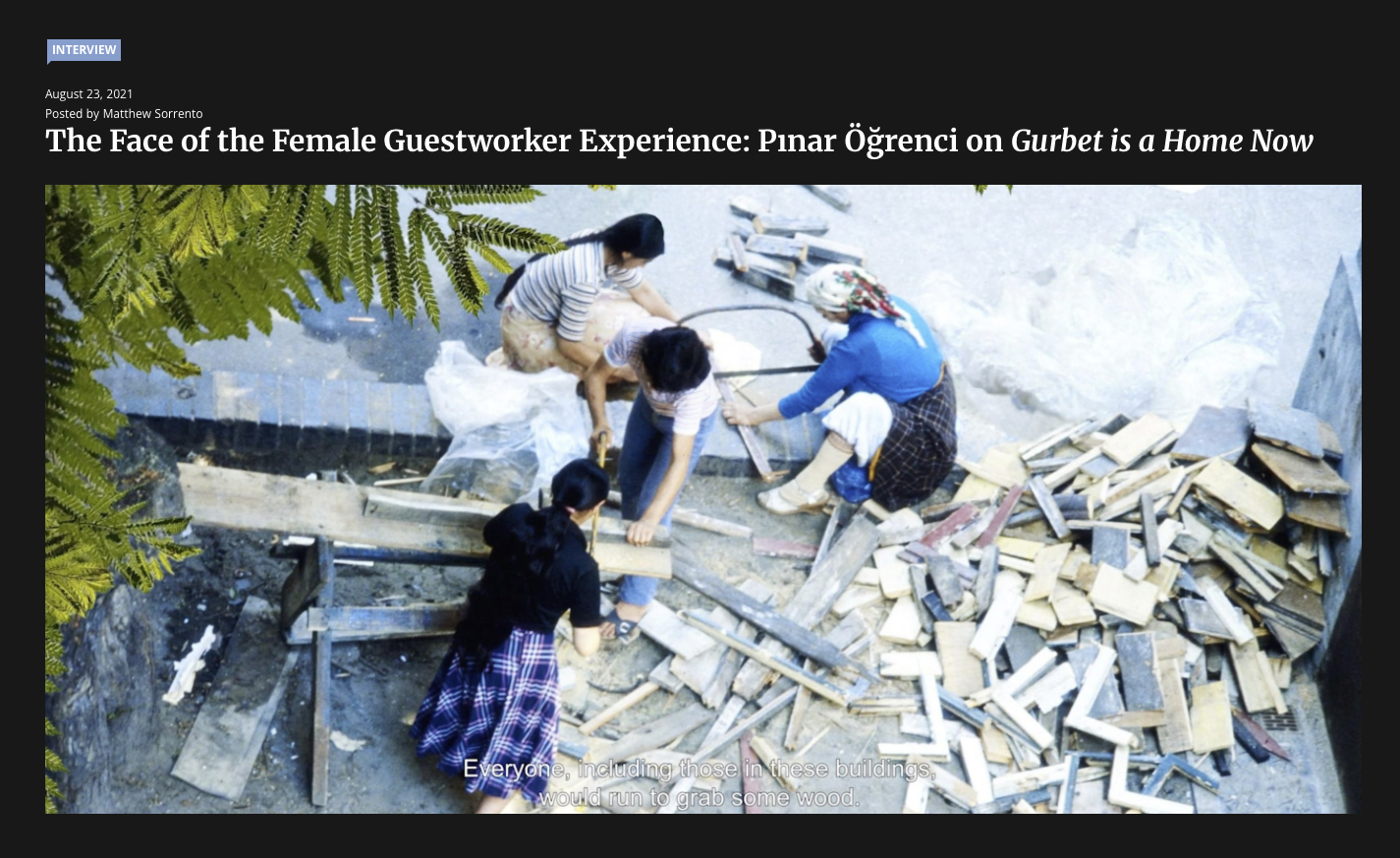
Interview by Pınar Öğrenci & Buket Cengiz, filminternational, 2021
I began to explore how the guestworker phenomenon was represented in literature, cinema, and music…. As one of the latest representatives of the new generation migrant artists, I wanted to follow the footsteps of the artists before me and join them by including this kind of expression in the film.”
At this year’s Documentarist – Istanbul Documentary Days, held on 3-11 July 2021, Pınar Öğrenci’s Gurbet is a Home Now (2021) received the Special Jury Award. Öğrenci is an artist and filmmaker from Turkey who currently lives in Berlin. Öğrenci, whose video-based work and installations have been exhibited widely in Germany and Turkey, as well as other countries such as Austria and Italy, has a background in architecture. In Gurbet is a Home Now she masterfully incorporates her perspectives as a filmmaker, artist, and architect as well as her deeply rooted interest in poetry and prose fiction as she unfolds the layers of the guestworker experience in Berlin, particularly through the female point of view.
Let us start with the relationship between Esra Akcan’s book, published in 2018, Open Architecture: Migration, Citizenship and the Urban Renewal of Berlin-Kreuzberg by IBA – 1984–87 and your film: how would you describe your film as regards the book? Would you describe your film as an extension of the book, as a supplement to the book, as based on the book, or something else?
Esra Akcan’s book Open Architecture is the main inspiration and source of the film; everything started with this book. This book which I came across in the first days of my migration from Istanbul to Berlin in 2018 was almost like a Berlin guide for me. As I read the book, I began to recognize the profile of Turkish migrants in Kreuzberg, and as I learned the reasons why generations before me migrated here, I felt like I was reading Turkey’s political history. Migration of the guestworkers triggered by the economic crisis after the 1960 military coup, political migrants of the human rights crisis before and after the 1980 military coup, Kurds and Alevis fleeing the attacks in Eastern Turkey in the 1990s: all painted a picture of Turkey.
And the Berlin of those years: Kreuzberg, at the edge of the Berlin Wall, in ruins after the Second World War, the transformation of the neighbourhood into a tourism and commercial area in the 70s and the Senate decisions approving the demolition of old buildings, the occupation movement that developed as a reaction against these decisions, and the long resistance. Then there was the Berlin Senate’s presentation of the IBA project which rejected demolition and advocated for the restoration of old buildings as a solution. There were various groups involved in this project, and the discrimination in daily life was once again implemented through urban policies. I discovered all these as I read the book and wanted to discuss them. Before starting the film, I asked Esra Akcan’s permission to benefit from her research and offered to collaborate on the film. Esra shared her work with me with great generosity.
…
Please use the link above for the full text.