Text by Pınar Öğrenci, 2014
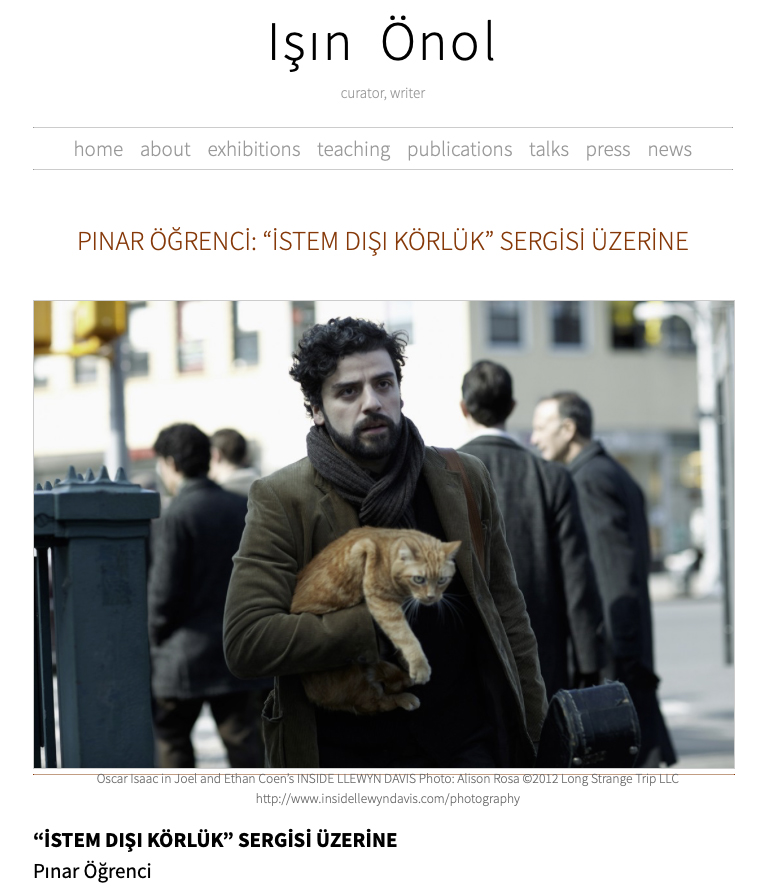
I had the chance to see the Coens’ latest film, Inside Llewyn Davis, in the Başka Sinema selection. As Oscar Isaac, in the role of Llewyn Davis, leaves the house where he has been a guest, a ginger cat slips out through the gap in the door. That cat and another that looks very much like it appear in many scenes in the first half. Hitchhiking to New York with a cat whose owner he does not know, our hero leaves the car he has been travelling in toward dawn, and he gets rid of the cat by leaving it in the car. Driving on the way back from New York on a snowy night, his eyes heavy with sleep, he hits an animal. He gets out of the car to look at it, and in the dark the camera shows an animal that resembles a fox, trying to limp toward the forest at the edge of the highway…
When we came out of the cinema, my friends insisted that the animal Llewyn hit was the cat he had abandoned on the road. I was sure it was a larger animal that looked like a fox. When I got home, I came across a few film reviews, in Turkish and English, that proved my friends right. Indeed, all of the reviews said it was a cat. Still, I held my ground. When I bought the DVD and watched the film again, I saw that the animal really was not a cat, but the majority did not say so… From the beginning of the film, the cat character had been shown so many times that not only the viewers but even the reviewers had made the mistake of taking the fox for a cat…
Zilberman Gallery hosted the exhibition İstemdışı Körlük (“Involuntary Blindness”), curated by Işın Önol. The exhibition, with Sophie Dvorak, Şakir Gökçebağ, Berat Işık, Claudia Larcher, Bernd Oppl, Liddy Scheffknecht and Aylin Tekiner, reads the act of seeing, one of the fundamental questions of art history, in reverse and focuses on “not seeing, becoming blind.” The mechanisms of state administration, the advertising and the media industries produce strategies that make what exists invisible. They ensure that we do not notice the events taking place before our eyes, or their real meanings. That the system stays standing in spite of everything is closely connected with this blindness in our perception.
In Dostoevsky’s novel The Idiot there is a wonderful dialogue about “seeing.” It takes place between Prince Myshkin, the “idiot” who is a symbol of goodness, and Adelaida, one of the daughters of the Prince’s distant relative Lizaveta Prokofyevna. Referring to Russia, Adelaida says, “For two years I haven’t been able to find anything to paint; in the east and in the south, everything has been used up.” Adelaida, who has studied painting, says she does not know how to see. She suggests that the Prince may have learned to see in Switzerland and asks him to teach her. In the landscapes she sees every day, Adelaida can find nothing that catches her interest. The East–West theme that runs through all of Dostoevsky’s novels shows itself in this short dialogue through “seeing.”
The exhibition begins with a selection of three videos by Berat Işık. The influence of cinema is clearly present in Işık’s video works. Cinema is the most accessible and widespread of the arts. The Western dream that Adelaida in The Idiotwants to reach comes into your living room by way of cinema. Işık uses the titles of cult films produced in the West. Against the overwhelming scale, technology and large crews of the Hollywood film industry -we could put in the same category the large productions of today’s video art, which approach cinema budgets, he makes a kind of irony with small-budget videos that content themselves with almost a single image, and he comes close to the minimalist, small-budget approach of contemporary Iranian cinema. His use of popular film titles in his own videos is meaningful, because with his limited means he seems to be saying, from the other end of the world, “this is how I would have done it.”
While Işık takes Western models as examples in the titles of his video works, in his choice of subject he looks, unlike Adelaida, not to far-off places but to his own surroundings, and he builds his images not in a narrative style but through the poetic, that is, through metaphor.
In Berat Işık’s videos we see a refined approach, strong in humor and based on extremely simple ideas. In Gözü Tamamen Kapalı (“Eyes Fully Closed”), the artist, constantly changing channels as he looks at the television screen, has the colors of the television light reflected on his face and body. Hopelessly changing channels in front of a screen that blinds whoever looks at it, the artist symbolizes the distressed, passive and defeated position of today’s person in front of technology. Just as T. Adorno points out that the behavior of a radio listener who keeps changing stations is “an aural kind of idling,” here too the artist is passing his free time bewildered and passive in front of the television.
In Karanlıkta Dans (“Dancing in the Dark”), someone on a black background calls out “I’m here.” The person represented by the voice, which wants to be seen, understood and accepted, could be the artist himself, or the whole Kurdish community. The acts of seeing and being seen are bound to each other: if we see someone, we accept that they see us too. Here, while the artist asks “do you see me?”, he is in fact also saying “I see you.” The “darkness” in the videos represents political deadlock and violence, and it reaches its peak as it is repeated in the video Kıyamet Lütfen(“Apocalypse Please”). There we see all the members of a large Kurdish family consciously choosing to become blind, as a kind of protest against the violence they face every day. We can say that this choice of blindness in fact contains a tactic developed against “the viewer’s potential for blindness.” This allows political discontent to rise to the level of a feeling of solidarity, and it holds a longing for a humane future. The weight of the images the artist builds shocks us by creating a kind of short circuit in our way of seeing.
Işık’s videos, which are related to one another and concentrate on seeing, are shown at the entrance of the gallery space, in a niche that at first glance is easy to overlook (“escapes the eye”). This makes us think about not seeing and about things slipping from sight, while the circular arrangement in which the videos are displayed connects with the form of the “eye.”
Aylin Tekiner’s three-channel, black-and-white video installation Dem/Eza/Yad focuses on the language in which the Halabja, Roboski and Sivas massacres are narrated. Media, official history books and oral transmission form collective memory, each contributing to the way information is manipulated and made social. Using the aesthetics of these three different modes of narration, Tekiner lays what is visible over what is hidden, swept under the rug, and so draws attention to the methods by which social perception is manipulated. What the artist has chosen to decipher from a political history full of massacres are events she has witnessed. Tekiner has seen how these events are distorted as they are passed on through the media, and how the state apparatus abuses its own power. With this work, through a singular effort, Tekiner makes visible the mass killings themselves, which carry repeated political dangers, and the mentality, lacking any sense of justice or conscience, with which they are conveyed to the public.
In her work Heim / Ev (“Home”), Claudia Larcher transforms a typical upper-middle-class Viennese house into a video, assembled mostly from photographs. The house, which we are able to follow from the attic down to the basement through an extremely slow camera movement, evokes a feeling of mythical fixity and abandonment. Yet as the camera wanders through the middle floors, characters such as the grandfather sleeping under a quilt, the gardener mowing the lawn, and a ghostly “guest” standing at a door where the bell is ringing are shown in concealed form. The sound edit, made from the sounds of the place, gives us a constant feeling of unease, as if a dark cloud or a shadow were drifting over the house. The artist deciphers her grandfather’s house, the house she grew up in, as the “home” model of the great majority who did not withhold their support from the Nazis in the Second World War. Architecture, interior space and the objects we use are loaded with the knowledge and testimony of history. The house therefore carries the spatial potential of shame and confrontation. If we think of the house as a vertical entity from attic to basement, the roof can be seen as the element that protects this entity and the “family” from outside influences, and the basement as the element that joins the structure to the earth and keeps it standing firmly. The roof symbolizes the privacy and sanctity of the family, the basement its unquestionable solidity and tradition. The closed box, the suitcase and the accumulated old things in the attic are loaded with the scattered knowledge of a past that has been swept under the rug. The walls of the house are built on the foundations of the basement, which is partly buried underground, and the foundation carries the whole house. In this sense the basement, or in Bachelard’s term the “cellar,” is “a symbol of sins whose atonement has not been paid.” The video ends with the loud noise of a roller shutter coming down after a car has driven out of the garage in the basement. This suggestive closing of the shutter seems to lock the secrets of the house inside.
Bernd Oppl makes his video works by intervening in small models he has made of architectural spaces that he depicts as empty. In his works the solid, masculine and unchanging architectural space is melted, coated with liquid or powdery substances, or turned around an axis, and as it takes on a feeble, sick and weak form, the space almost disappears. When we see architecture in a sick and fragile condition, like a human being, our perception of the space’s solidity and strength becomes blurred.
The tension of the exhibition, which begins with the political works of Berat Işık and Aylin Tekiner, is consolidated by the unsettling videos of Claudia Larcher and Bernd Oppl, and rises with Sophie Dvorak’s screenprints titled Agree, Demonstrate and Arrest. In Dvorak’s drawings we see images of international agreements collected from newspapers, the protest marches organized against these agreements, and then scenes of the protesters being arrested. Dvorak questions how the images of social types, which we see again and again in the mass media in scenes of agreement, protest and arrest, normalize these scenes and destroy their content.
The works of Şakir Gökçebağ and Liddy Scheffknecht coincide with the exhibition’s conceptual text in terms of their plastic values. The artists’ works, based on optical illusion, look as if they had been digitally manipulated, but the retouching applied is physical, not digital.
When modern society reproduces itself with all its violence, it uses communication tools with mechanical equipment. That most of the works in the exhibition were produced with the camera, a mechanical means of communication (photography and video), and that architecture, which uses mechanical means of communication, is the subject of many of the works, strengthens the conceptual framework of the exhibition. As W. Benjamin also notes, while a “painting” invites the person to contemplation, film shocks and blinds them. We mistake the animal Llewyn Davis hits for a cat, we are blinded by the light of the TV, we grow used to the images in newspapers and believe the news is true. Like Adelaida, we do not see what is happening beside us because we look at the same view every day, or we do not confront history because we are afraid of what we should be seeing. In these days when we are going through hard times as a society, the exhibition Involuntary Blindness was a good opportunity to perceive what is happening better.